Synopsis
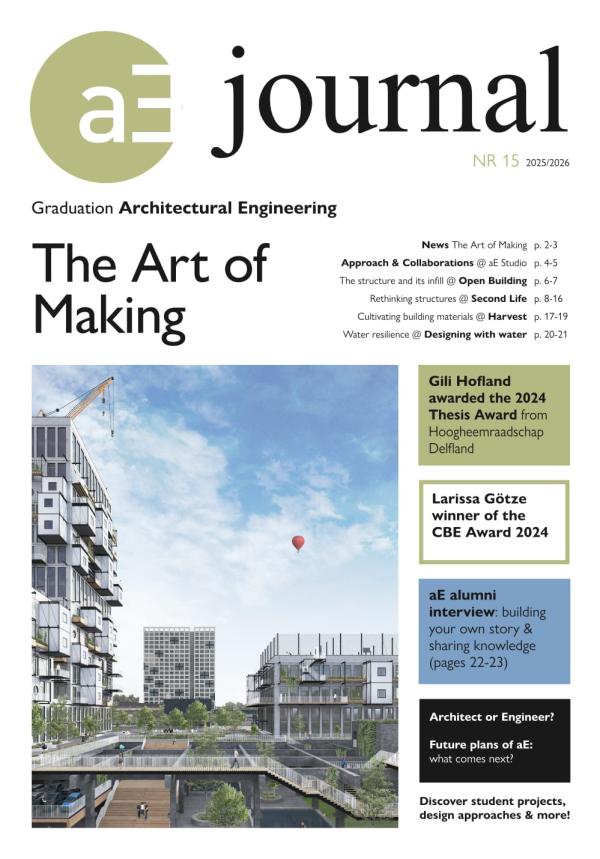
Welcome to the new edition of the aE Journal, presenting the graduation plans from the aE graduation studio. Guided by the themes of framing the freedom and open design, aE students have worked on improving our built environment in diverse and innovative ways.
As I write this edition of the aE Journal, I find myself reading Thinking Architecture, a cahier by Peter Zumthor - still, for me, one of the true masters of expressing architecture through material.
Designing is inventing
One theme that struck me is what Zumthor describes as “the constant urge to innovate”, raising questions such as: Who are your role models? What problem are you trying to solve? What role does architectural history play in your design process?
Even though we rarely create something entirely new, each era brings its own emphasis, its own needs, and its own narrative.
Innovation & knowledge building
When addressing today’s environmental challenges, I enjoy bringing past pioneers into focus during my lectures: Jean Prouvé with his (circular) connection techniques, Charlotte Perriand with her (bio-based) chalet designs, and Auguste Perret, who - together with fellow architects - created entire city center from a rational approach to material and technology. What all these examples have in common is that their designs often began at a small, craft-based scale, and only when proven promising were they scaled up to industrial applications.
How different things are today, where in some sectors - like housing - “industrial” is the starting point. Rather than growing out of design ambitions, industrial processes are often driven purely by technological possibilities.
Back to Zumthor, who writes: “Construction is the art of making a meaningful whole out of many parts.” Where he likely refers to the architectural object itself, I would extend the comparison to include today’s architecture and its contemporary pioneers.
(Structural) engineer as (urban) architect
Today’s discourse on “making cities” seems increasingly reduced to pragmatic discussions of money and numbers. Sustainability and circularity are too often treated as purely technical responses to process-related challenges. But do they also enrich our experience - our perception of space, our physical surroundings, our intrinsic needs?
In the 20th century, a housing shortage led to monotonous construction processes, where tunnel formwork became the norm. Are we repeating this in 2025? Can we advocate for the best of both worlds: using rational manufacturing technologies to support the construction process, while simultaneously striving for architectural expression rooted in human creativity and interaction.
The art of making
Students are encouraged to explore this discourse by placing the art of making at the center of their work. Debate and dialogue are essential to maintaining an open attitude toward engineering and architecture, materials and construction. There is still much to gain in developing a culture of open building.
Let construction, assembly, and composition (once again) become foundational knowledge in design education to inspire industrial development - so that, even Vitruvius can be reinterpreted for the modern age.
Downloads
Download data is not yet available.
Keywords:
architectural engineering, architecture, TU Delft, DelftPublished
18 July 2026

Copyright (c) 2026 Emma van Barneveld; Anne Snijders; Klaudia Kurzacz; Mo Smit, Tslil Strauss, Yannick Warmerdam