Synopsis
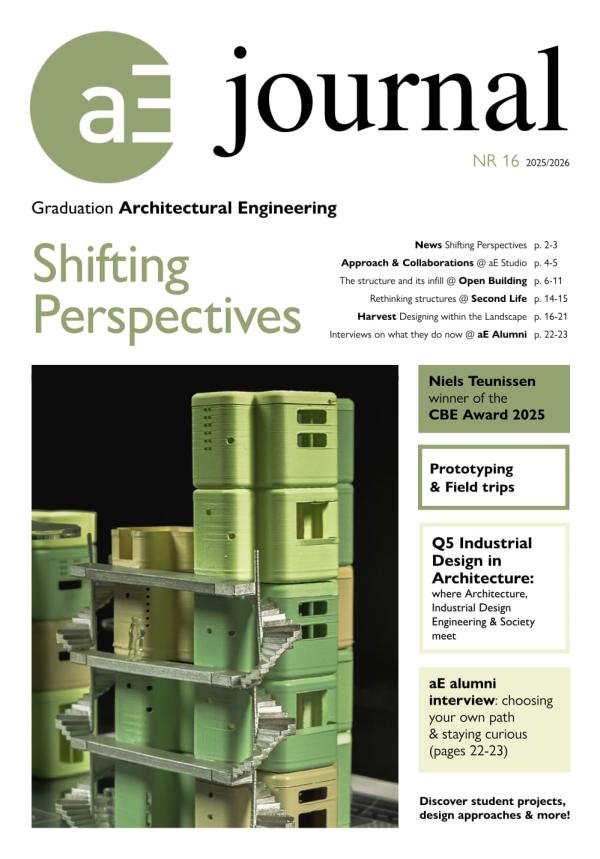
Welcome to the new edition of the graduation work from the Architectural Engineering Graduation Studio. A studio that has structured its program around sustainability and circularity challenges. Through approaches such as “Open Building,” “Second Life,” and “Harvest,” it offers different perspectives. Materials and production methods are critically examined, leading to new insights and design opportunities.
Shift
The development of circularity, digitalization, and industrialization within the construction sector also reveals a broader shift: the transition from buildings as unique objects to buildings as product- and system-based assemblies.
Where circularity was once primarily a sustainability ambition, it is now becoming a fundamental design principle from the very start of the process. Buildings are increasingly designed as material banks, where components can be disassembled and reused at the end of their lifecycle.
From Architecture to Industrial Design
Due to the rapid growth of modular and prefabricated construction systems, production is shifting toward controlled factory environments. Instead of traditional on-site construction, building elements are developed as standardized modules that can be easily assembled, replaced, or extended. Modular construction therefore transforms architecture into a matter of systems design rather than purely spatial composition.
There is also a growing focus on material innovation. Materials are no longer selected solely based on aesthetics or structural performance, but increasingly on their full ecological and circular potential: reusability, CO₂ impact, and disassembly potential. As a result, materials themselves become design objects, comparable to product components in industrial -design.
From Specific to Generic
Architecture is thus becoming less of a one-time act and more a continuous process of development, testing, and improvement. Within the Architectural Engineering Graduation Studio environment, this shift becomes visible in the way projects are approached: not only as spatial proposals within a specific context, but as prototypes of a larger system.
Within this development lies an important opportunity: architecture can evolve into a discipline that not only responds to societal challenges, but actively helps shape them through thoughtful, reusable, and scalable design solutions.
Downloads
Download data is not yet available.
Keywords:
Architectural Engineering, Architecture, TU DelftPublished
18 July 2026

Copyright (c) 2026 Emma van Barneveld; Anne Snijders, Mo Smit, Baan Taweel, Camille Gbaguidi
Details about this monograph
Date of first publication (11)
01-07-2026