Book of Abstracts
History of Games 2026
The Ages of Games: Epochs and Periodisations
Downloads
Synopsis
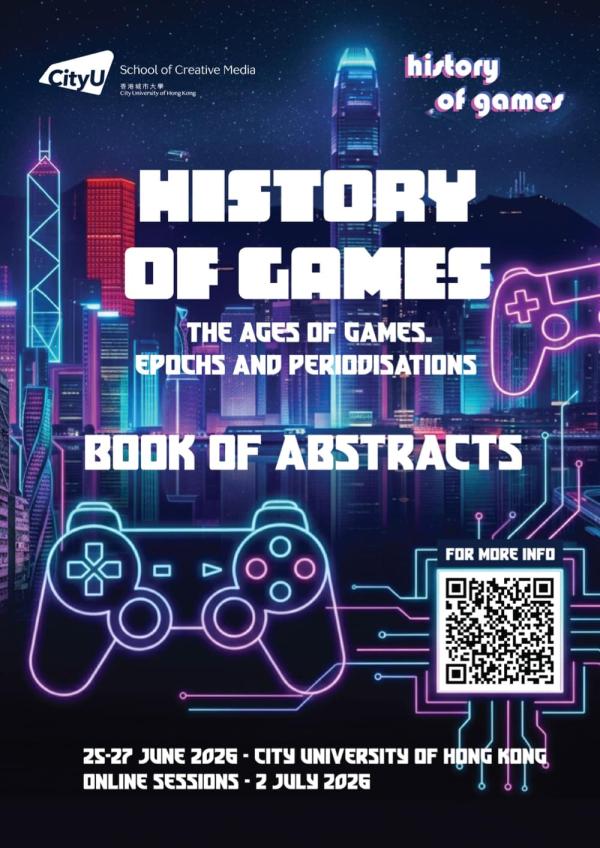
The 2026 edition of the History of Games International Conference, took place at City University of Hong Kong, 25–27 June 2026, with an online day on 2 July 2026. This volume collects the abstracts presented at the conference under the theme The Ages of Games: Epochs and Periodisations.
Our 2026 conference featured keynote addresses by Dr Akiko Sugawa-Shimada of Yokohama National University on Women, Japanese History, and Videogames in Japan: Female Fans’ Heritage Tourism as Game-adjacent Cultural Phenomena. The talk examined how Japanese video games and their cross-media adaptations helped expand female participation in historically male-dominated gaming and history cultures. For day 2 of the conference Dr Paolo Pedercini from Carnegie Mellon University presented A History of Video Games Through Mass Extinctions. The keynote thereby offered a materialist history of videogames through industry crises and mass extinctions, arguing that each rupture reshaped what kinds of games, labour models, and cultural possibilities could survive under changing relations between capital, developers, and players.
History is often divided into epochs, be they ages, periods, dynasties or eras. The history of popular culture is no different: cinema, for example, has the cinema of attractions, the silent period, the age of vanguards, post-war movements such as the New Waves or the Italian Neorealism, the New Hollywood, the age of V-Cinema and OVA, and the international rise of independent films. Similarly, games and video games have Golden Ages, revolutions, generations, crashes, and many other popular ways to identify discrete segments of their own histories. To study the history of games is to think about epochs defined by shared traits and bookended by transformative events.
How is this periodisation done, and by whom? Who are the stakeholders of this conceptualisation? What are the main criteria to define periods? How does the concept of epochs differ between the spheres of academia, criticism, and popular gaming culture? Epochs can be proposed and accepted by the public according to technology, impact of/on other areas outside of the medium, and even artistic trends and movements. They often tell a unified story that is useful in simplifying the ebbs and flows of the history of the medium, but can hide key events, actors, and regions.
The open call for History of Games 2026 invited considerations of what periodisation is in the context of game histories: for example, already established and accepted periods, alternative ones, problematisations of epochs or international and regional periods and their coexistence. What are the best ways to discuss gaming’s epochs, and what methods can be used to anchor them? What can we learn (and unlearn) by questioning these ages of games?
Our peer-review process yielded 59 presentations from an international cohort of 65 research scholars, the abstracts of which can all be read in this volume. We are grateful to everyone who gathered in Hong Kong and online to make this year’s edition of History of Games such a great success. The 2026 conference was our third consecutive yearly edition, and firmly locks in History of Games as an annual event going forward.
Downloads
Download data is not yet available.
Keywords:
Game Histories, Game StudiesPublished
29 October 2026

Copyright (c) 2026 Copyright in each abstract remains with its author(s)
Details about this monograph
ISBN-13 (15)
978-94-93439-23-8